


Financial Incentives vs. Cultural Initiatives: A Guide to Reducing Manufacturing Turnover (August 2025)
- Adriana Gutierrez, Digital Media Producer

- 22 ago 2025
- 4 Min. de lectura
Actualizado: 26 ago 2025
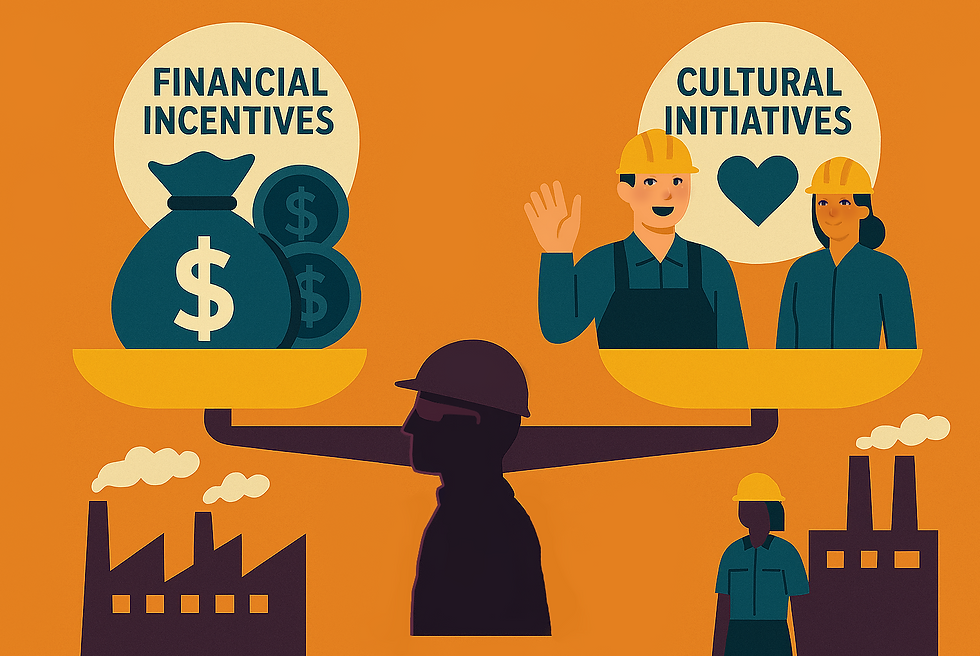
Manufacturing leaders today face a critical challenge: high employee turnover. The costs of replacing a skilled employee can be substantial, often ranging from $20,000 to $40,000 for a single frontline worker (Marsh McLennan Agency, How to reduce turnover in manufacturing, June 2025). To combat this, companies often turn to two distinct strategies: financial incentives and cultural initiatives. While both aim to retain talent, understanding their strengths and limitations is key to building a workforce that is both stable and engaged.
The Case for Financial Incentives
Financial incentives are a direct and immediate way to reward employees. This includes competitive wages, performance-based bonuses, profit-sharing, and sign-on or retention bonuses. The primary strength of this approach is its clear and tangible value to the employee.
Pros:
Direct Impact: Bonuses tied to performance can directly motivate employees to hit production targets. Research indicates that such bonuses are particularly effective in manufacturing, where they are often perceived as a fair reward for hard work (ResearchGate, Financial incentives as a tool to retain employees, August 2025).
Short-Term Retention: Retention bonuses can be a powerful tool to prevent key employees from leaving during critical periods, such as a major project launch or a period of high demand.
Cons:
Limited Shelf Life: The motivational effect of a bonus or a raise can be short-lived. Once the initial excitement fades, employees may begin to seek other opportunities if their core needs are not met.
Not a Complete Solution: Data shows that while pay and benefits are a primary reason for employees to leave, a lack of career development, a poor work environment, and insufficient recognition are also major factors (Paycor, 13 Employee Retention Statistics Employers Need to Know, April 2025). A competitive wage is now a baseline expectation, not a differentiator.
The Case for Cultural Initiatives
Cultural initiatives focus on building a work environment where employees feel valued, respected, and connected. This includes strong onboarding programs, opportunities for professional development, effective manager training, and a focus on employee well-being.
Pros:
Long-Term Loyalty: A positive culture fosters a sense of belonging and loyalty that money alone cannot buy. According to a recent survey, employees who feel recognized are two times as likely to stay with a company (TeamSense, How to Reduce Employee Turnover in Manufacturing, July 2025).
Improved Engagement: A strong culture is directly linked to employee engagement, which has a significant impact on retention. In fact, highly engaged business units see as much as 51% less turnover in low-turnover organizations (Gallup, State of the Global Workplace Report, July 2025).
Cons:
Intangible & Complex: Culture is more difficult to measure and change than compensation. Its effects are often less immediate and require consistent effort from management at all levels.
Not a Standalone Solution: While a strong culture is critical, it cannot compensate for a sub-par salary. A holistic strategy requires a competitive financial foundation upon which a positive culture is built.
The Holistic Approach in Practice: A Case Study in Combined Strategies
A leading manufacturer of industrial components has successfully reduced its production staff turnover by over 40% in the last two years. Their success is not based on a single strategy, but on an integrated, two-tiered approach:
Financial Foundation: The company ensures its wages and performance bonuses are competitive with market rates. Pay raises are reviewed annually based on performance and inflation, ensuring employees feel their value is fairly recognized.
Culture of Empowerment: On top of this financial foundation, the company has invested in cultural initiatives. Managers receive regular training in communication and leadership skills to create a positive, supportive environment. An "Employee of the Month" program has been implemented where coworkers nominate a peer for recognition, fostering respect and appreciation among the team. Additionally, the company invests in employee professional development through courses and certifications, demonstrating a commitment to their long-term growth.
The result is a virtuous cycle: fair compensation retains top talent, and a supportive culture motivates them to perform at their best and stay with the company, creating a sense of purpose that goes beyond the paycheck.
Making the First Move: A Roadmap for Your Company
Understanding the benefits of a holistic approach is the first step; taking action is the next. Here is a roadmap to help your company begin to implement a combined strategy for a more resilient workforce.
Conduct an Employee Survey: Begin by gathering data on what your workforce truly values. Are they motivated by financial rewards, recognition, or career development? This feedback is the foundation for a targeted strategy.
Train Your Managers: Equip managers with the skills to provide regular, constructive feedback and build positive team dynamics. Strong managers are the single most important factor in employee retention.
Create a Culture of Recognition: Implement a simple, consistent program that publicly recognizes hard work. This can be as basic as a digital "Thank You" board or a peer-nominated award.
Show a Clear Career Path: Demonstrate a commitment to your employees' futures by outlining a clear path for growth within the company. This can include training programs, mentorship, and opportunities to take on new responsibilities.
Conclusion: The Holistic Approach
In August 2025, the most successful manufacturers are abandoning the "versus" mentality. Instead of choosing between financial incentives and cultural initiatives, they are integrating them into a comprehensive strategy. The data is clear: while fair compensation is a fundamental requirement, a positive work environment is what truly drives long-term retention. By investing in both competitive pay and a culture of respect, recognition, and growth, manufacturers can not only reduce turnover but also build a more resilient and productive workforce.